
“Cockroaches,” “lice,” “parasites.” These were the words Nazi propaganda used to describe Jews, preparing society for their persecution and extermination. Now similar expressions are used by Russian propagandists against Ukrainians. On October 9, 2026, Ukraine’s permanent representative to the UN, Andriy Melnyk, directly compared Russian threats to the Nazi “final solution to the Jewish question.”
Author: Victoria Katsman | NAnovosti — News of Israel
At an emergency meeting of the UN Security Council in New York, the diplomat quoted Russian TV host Vladimir Solovyov, who threatened the residents of Kyiv, Odesa, and Mykolaiv, and former Russian President Dmitry Medvedev, who spoke of the destruction of Ukrainians.
The comparison was made against the backdrop of new Russian strikes on Ukrainian cities. In his speech, Melnyk linked hate speech, the death of civilians, and international responsibility for preventing mass crimes.
“We are thinking about where to bury them all”: what was said at the UN
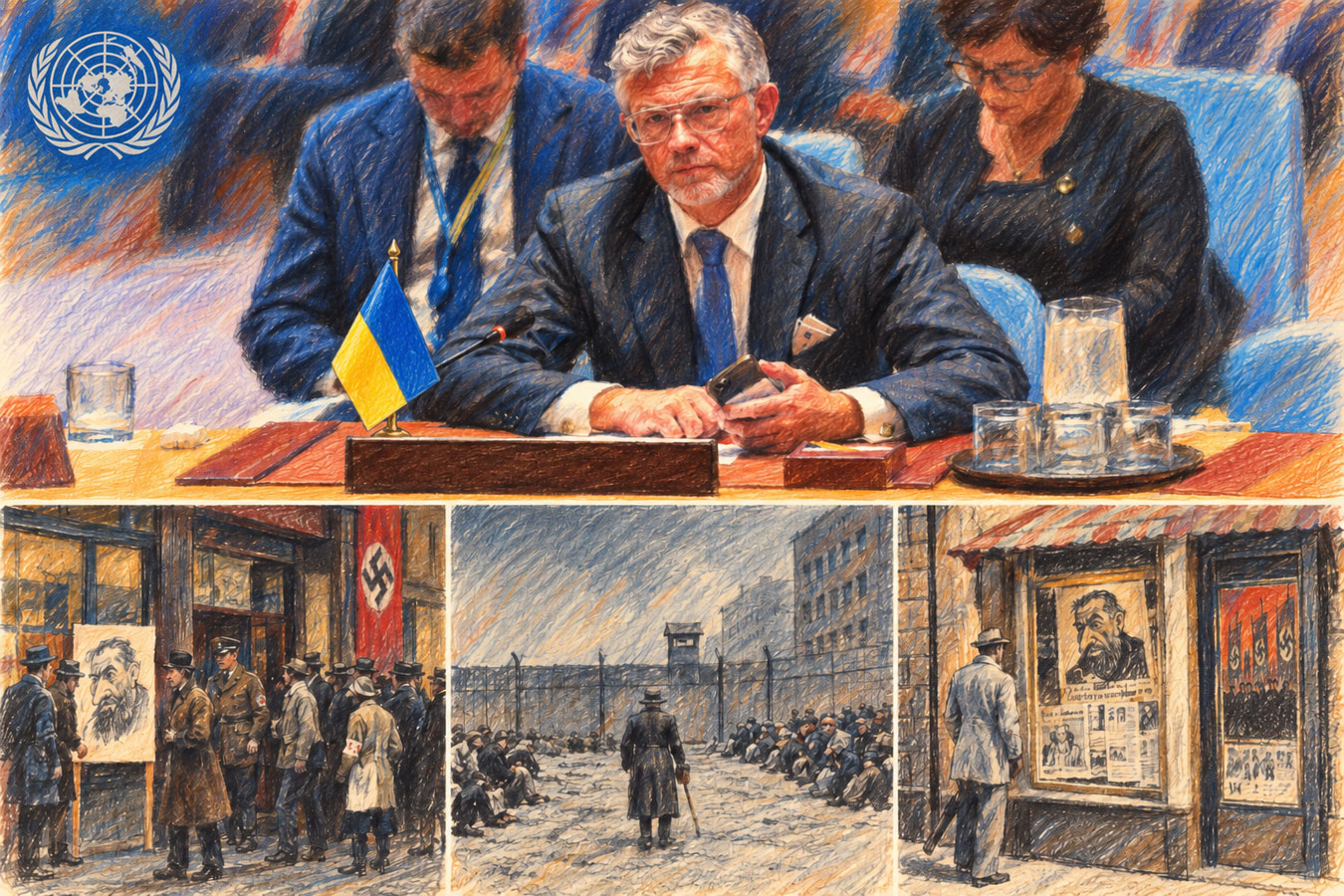
The meeting on October 9 was convened at Ukraine’s request with the support of Denmark, France, Latvia, and the United Kingdom. Greece presided.
Andriy Melnyk stated that the Russian leadership seeks not just to capture Ukrainian territories but to destroy the Ukrainian nation. As an example, he cited a statement by Vladimir Solovyov, which, according to the diplomat, was made a few days earlier on television.
Solovyov demanded that the remaining residents of Kyiv leave the city, warning: “You are doomed.” He extended the same threat to Odesa and Mykolaiv, stating that their residents had already “laughed.” After this, the TV host spoke about the fate of the population of the three cities.
“We are thinking about where to bury them all.”
Melnyk emphasized that this is not a figurative expression. In his assessment, Russians openly discuss the mass killing of Ukrainians and the subsequent burial of their bodies.
The diplomat then quoted Dmitry Medvedev, former President of Russia, now Deputy Chairman of the Security Council of the Russian Federation:
“They must be destroyed. That’s all.”
In Melnyk’s speech, it was clarified that by the word “they,” Ukrainians are meant.
He also listed the designations that, according to him, were used by representatives of the Russian leadership: “tumors,” “rabid dogs,” “cockroaches,” “lice,” “parasites.” The need for “disinfection” was also mentioned.
It was after these examples that Melnyk compared the alleged goal of the Russian leadership with Hitler’s “final solution to the Jewish question” — the Nazi program for the extermination of European Jews.
The full speech of the Ukrainian representative was published on October 14, 2026.
The Nazis did not start with gas chambers. First, Jews were gradually deprived of civil rights, fired from jobs, pushed out of professions, excluded from public life, and had their property taken away. At the same time, state propaganda shaped the image of the Jew as a dangerous outsider, a parasite, and a source of disease.
In 1940, the anti-Semitic propaganda film “The Eternal Jew” (Der ewige Jude) was released. It used images of parasites and rats to spread ideas about Jews as a biological threat.
In March 1941, a Nazi poster was distributed in occupied Poland, linking Jews with lice and the spread of typhus. Such materials were used to justify the isolation of the Jewish population in ghettos.
This is evidenced by the archives of the American Holocaust Memorial Museum. Nazi propaganda portrayed the persecution of Jews as the protection of society. The result of state policy was the murder of six million European Jews.
For Israelis, this history is not limited to the pages of textbooks. In Jerusalem’s Yad Vashem — the national memorial complex in memory of the victims of the Holocaust — documents, photographs, and testimonies are preserved showing how discrimination, propaganda, and state violence led to the Catastrophe of European Jewry.
The comparison made by Melnyk does not imply a statement of complete historical identity between the Holocaust and the Russian war against Ukraine. Its subject is the language of dehumanization, which allows the destruction of people to be presented as an acceptable action.
Russian propaganda simultaneously uses accusations of “Nazism” against Ukraine and spreads statements denying Ukrainians the right to exist as an independent nation.
NAnovosti previously wrote about this substitution in the article “Historical Falsification: How Russian Propaganda Obscured Centuries of Peaceful Coexistence of Ukrainians and Jews”. Researchers of Ukrainian-Jewish relations explained how separate tragic episodes of shared history are turned into a tool of modern Russian information warfare.
From television threats to real casualties
At the Security Council meeting, Melnyk presented data from the UN Human Rights Monitoring Mission: from January to August 2026, 2,222 civilians were killed in Ukraine, and more than 13,000 were injured.
According to the diplomat’s calculations, the number of dead and injured increased by 55% compared to the same period in 2025. On average, there were about 400 victims weekly.
Melnyk spoke about the strike on October 7 on a five-story residential building in Pryluky, Chernihiv region. According to him, at least 22 people died, including five children. A five-year-old girl named Zoryana, who lost her family, was rescued from the rubble.
On October 8, a Russian guided aerial bomb, according to the UN, hit two passenger buses in Kramatorsk. At least 33 people were killed, and at least 18 were injured.
UN Assistant Secretary-General Khaled Khiari also reported that over 100 civilians were killed in Ukraine in just one week, with at least 429 injured.
The Ukrainian diplomat separately spoke about strikes on energy facilities, water supply, sewage systems, hospitals, schools, universities, data processing centers, and mobile communications.
According to his information, on September 28, a Russian drone struck the historic building of the National Academy of Sciences of Ukraine in Kyiv, killing two people. Since the beginning of October, Russian strikes have affected bridges across the Dnipro, including the Southern and Northern ones.
Melnyk compared the danger of destroying urban transport links to the destruction of the Old Bridge in Mostar in 1993, during the Bosnian War.
His argument was that strikes on vital infrastructure can turn living in large cities into a struggle for survival.
Oleshky: about two thousand people without food and safe evacuation
A separate part of Melnyk’s speech was devoted to the occupied Oleshky in the Kherson region, on the left bank of the Dnipro.
According to data presented by the UN on October 9, about 2,000 people remained in the city, including 35 children. Residents were experiencing a shortage of food and medical assistance. Mines and drone attacks made evacuation routes dangerous, and there was no organized safe exit.
Melnyk stated that humanitarian aid was blocked and demanded the opening of corridors for the evacuation of civilians.
He reminded the Security Council of resolutions 2139 and 2165, adopted in 2014 in connection with the humanitarian crisis in Syria, and resolution 2417 of 2018, condemning the use of hunger against civilians as a method of warfare.
A historical parallel with the Holodomor — the mass famine of 1932–1933 in Soviet Ukraine, recognized by Ukraine and several countries as a genocide of the Ukrainian people — was also mentioned at the meeting. Melnyk also compared the blockade of Oleshky to the siege of Leningrad by Nazi Germany.
What international law says about calls to destroy a people
On December 9, 1948, the UN General Assembly adopted the Convention on the Prevention and Punishment of the Crime of Genocide. Article III provides for responsibility not only for genocide itself but also for direct public incitement to commit it.
Article IV extends such responsibility to government representatives, officials, and private individuals.
This fundamentally distinguishes direct calls to destroy a national group from ordinary political insults. However, to establish an international crime, it is necessary to prove specific circumstances, intent, and the nature of the call. Legal recognition of genocide does not automatically arise from historical analogy.
The Ukrainian position is that such public statements should be considered together with the actions of the Russian armed forces and policies towards the Ukrainian population.
Israeli perspective: Solovyov, the Chief Rabbi of Ukraine, and the memory of the Holocaust
For Israel, this story also has a direct contemporary connection. Solovyov has already used the theme of the Holocaust in public attacks on Jewish representatives of Ukraine.
On June 30, 2026, on his program, he attacked the Chief Rabbi of Ukraine, Moshe Asman, after the rabbi’s meeting with Dmytro Korchynsky.
Asman is a citizen of Israel and Ukraine. He lived in Israel, received rabbinical education, served in the IDF, and since 1995 has been involved in the revival of Jewish life in Kyiv.
NAnovosti thoroughly analyzed this episode in the article “How Russian Court Propagandist Solovyov Tried to Insult Ukrainian Rabbi Asman”. In his television appearance, Solovyov appealed to the memory of six million murdered Jews while simultaneously insulting the rabbi.
Another example is Russian anti-Semitic plots around the annual pilgrimage of Hasidim to Uman, a Ukrainian city where the grave of Rabbi Nachman of Breslov is located. In October, NAnovosti analyzed the spread of false reports about privileges for Jews, mobilization, and the alleged “Jewish autonomy”.
In the original appeal regarding Melnyk’s speech, written on behalf of the honorary consul of Israel, it is emphasized separately: the memory of the Holocaust should not be limited to monuments, ceremonies, and speeches on the anniversaries of the tragedy.
This thesis carries special weight in a country where survivors of the Catastrophe and their descendants live, and many families preserve the memory of relatives who perished from Ukraine.
However, an honorary consul is not an ambassador. His public assessments cannot automatically be considered the official position of the Israeli government.
Rwanda, the UN Security Council, and the danger of becoming accustomed to mass killings
Melnyk reminded Security Council members of the genocide of the Tutsi in Rwanda in 1994. The mass killings lasted about a hundred days; propaganda against the Tutsi also used derogatory names, including comparing people to cockroaches.
The diplomat’s historical conclusion was the need to respond to warnings before mass graves appear.
He also accused the Russian leadership of trying to make mass violence familiar to the international audience: first, another strike causes shock, then dozens of deaths turn into a regular line in the news feed.
In the international part of his speech, Melnyk touched on the situation at the front, Russian military spending, threats to Ukrainian food exports through the Black Sea, and the use of Belarus to support the operation of Russian strike drones.
According to his estimates, in September, Russian losses in killed and wounded exceeded 46,000 people. He also disputed Putin’s statement about the capture of 1,300 square kilometers of Ukrainian territory, citing independent geolocation studies, and demanded the restoration of safe navigation and grain exports.
Concluding his speech, the Ukrainian representative called on the Security Council member states to prepare a resolution demanding the cessation of Russian attacks, the withdrawal of troops from Ukraine, and the achievement of peace based on the UN Charter.
Eighty-one years after the end of World War II, the Security Council once again had to listen to words about the destruction of people based on nationality.
“Never again” is not only a promise to remember the six million murdered Jews. It is also a commitment to notice the danger before threats turn into new mass graves.
This is exactly what Andriy Melnyk reminded on October 9, 2026. It remains to be seen whether decisions will follow the warning.