
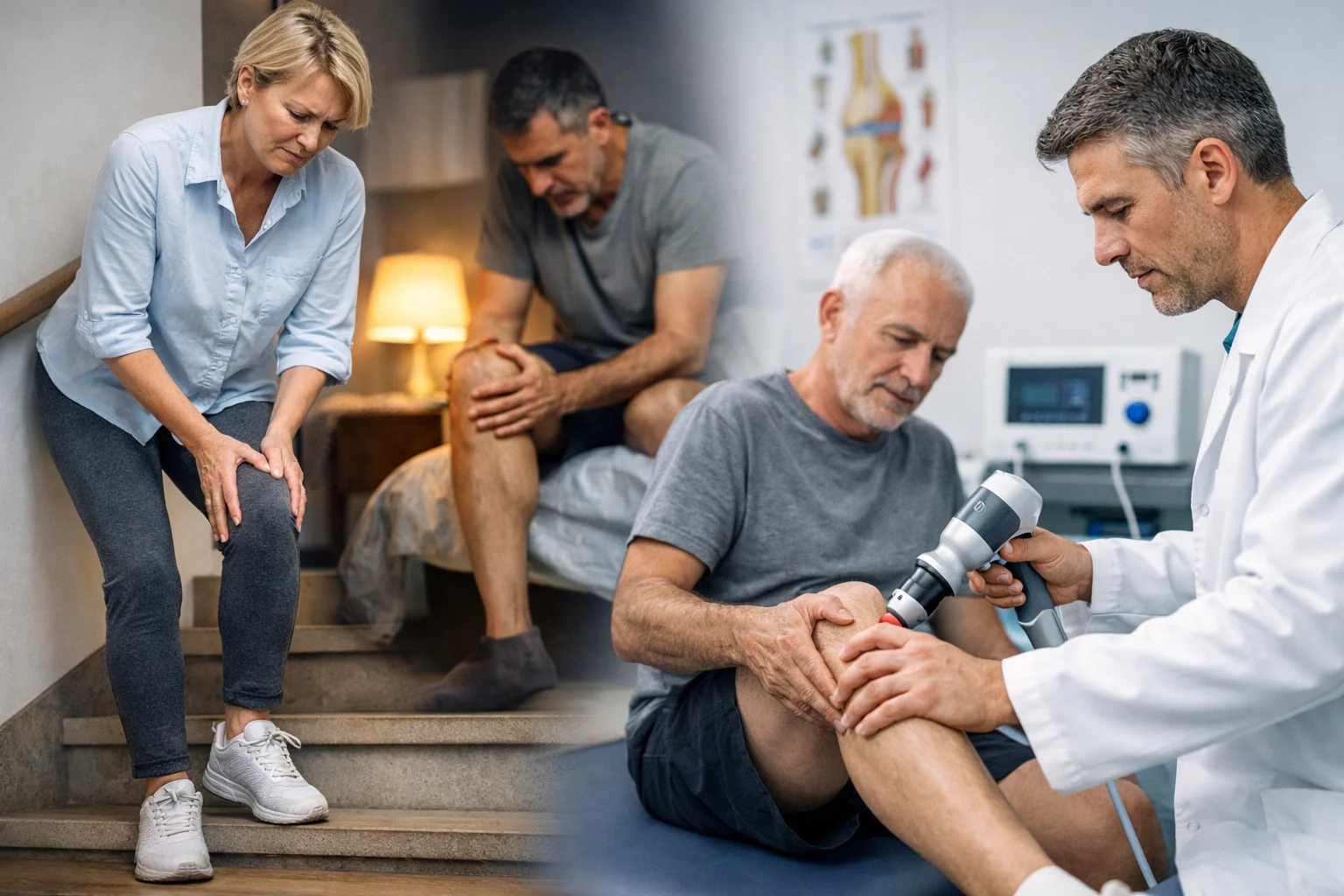
On the website https://uvt.nikk.co.il/ the David Sendler Pain Treatment Clinic in Israel describes shockwave therapy as a non-surgical approach for chronic pain, lists appointments in Haifa, Krayot, Akko, Nahariya, Afula, Yokneam, Petah Tikva, Netanya, Hadera, and Kfar Saba, and also notes the possibility of home visits in a number of areas. It also states that one session usually takes about 10–20 minutes, and a course most often consists of 3–6 procedures with an interval of 5–10 days.
Heel pain rarely begins as a major problem. More often it is a story a person first tries not to notice. Today it is a little unpleasant to step on the heel in the morning. Tomorrow the heel reminds them of itself after a long walk. Then it becomes difficult to walk quickly, stand longer at work, or calmly go down stairs. And now an ordinary day in Israel — with the road, shops, transport, stairs, and constant movement — begins to adjust to one painful point.
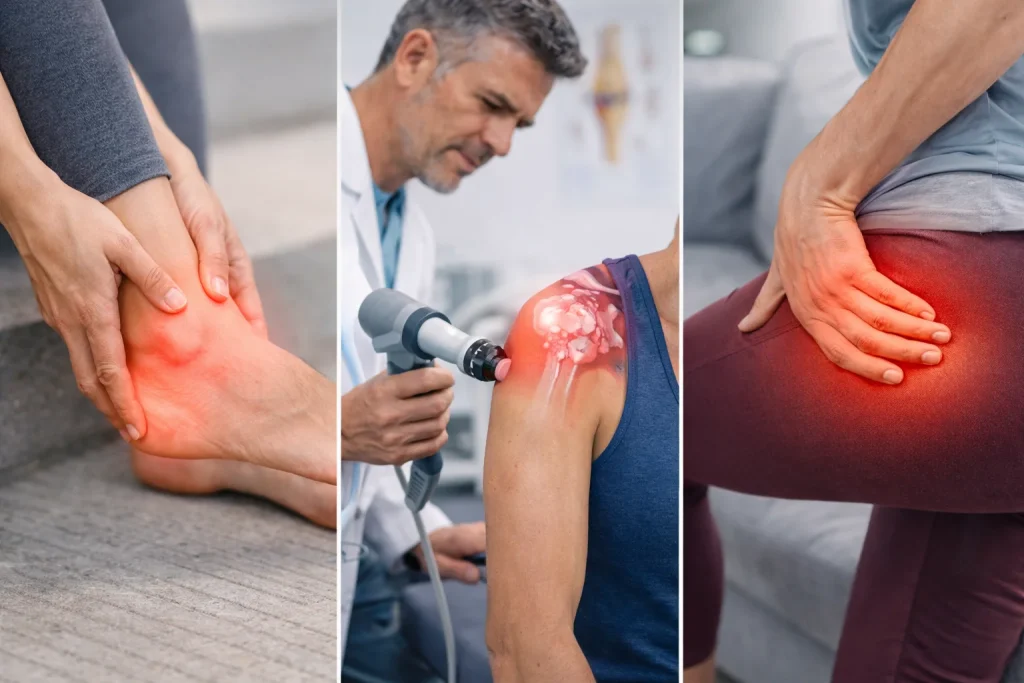
This is exactly where the main mistake of many patients lies. While the pain is still tolerable, it seems possible to wait it out. But heel pain almost never exists in a vacuum. It quickly affects gait. A person shifts weight to another part of the foot, protects one leg, changes their step, and then overloads the calf, knee, or lower back. Therefore, the issue is not only how to remove an unpleasant sensation, but how not to let the problem spread further.
Why the heel starts hurting more in everyday life
For most people, the most unpleasant moment is the first steps after sleep. Then the foot seems to “walk it off,” but by evening after ordinary activity everything comes back. This scenario is very familiar to patients with heel pain, especially if they walk a lot on hard surfaces, wear shoes without enough cushioning, or are used to walking barefoot on tile floors at home. On the page about the home approach, the clinic directly writes that in Israeli reality one of the main triggers is daily barefoot walking on tile, as well as long routes, stairs, and hard everyday footwear. https://uvt.nikk.co.il/how-to-treat-heel-spurs-at-home/
This is important because many people continue looking for the cause only in the diagnosis on paper. But in practice, what hurts is not only the “name of the problem,” but the overloaded area that takes an удар with every step. If this mechanics is not changed, the heel continues to be irritated. That is exactly why it may seem to a person that they are being treated, while the improvement remains short-lived.
Why home measures sometimes help, and sometimes do not
Home help is not useless, but it requires discipline. On the page about home treatment, the clinic offers not one random recommendation, but an entire short plan for 10–14 days: do not walk barefoot, wear shoes at home with arch support and a soft heel, reduce impact load, rethink walking on stairs, and add calf muscle and plantar fascia stretching in the morning and evening. It also separately emphasizes that reducing traumatic load is the foundation without which everything else works more weakly. https://uvt.nikk.co.il/how-to-treat-heel-spurs-at-home/
But the problem is that many patients use such measures inconsistently. One day they try, then they again walk many kilometers, then they change one insole for another, then return to old shoes, then tolerate the pain again. As a result, the heel lives in a regime of constant swings: a little better, then worse again.
This is where the main practical difference appears between random self-help and a clinical approach. In the clinic, what matters to the patient is not only the procedure itself, but also the sequence: understand the nature of the pain, remove everyday triggers, assess whether it makes sense to continue with only a home regimen, or whether it is already time to add more active treatment.
Why the clinic’s geography also matters
When it comes to chronic pain, people need not only to know about the method, but also to understand where they can actually get help. On the page for Haifa, the clinic writes that residents of Northern Israel have the opportunity to receive a specialist consultation about shockwave therapy and a trial procedure, while home visits are offered for regions from Netanya to Nahariya and from Haifa to Afula. It also emphasizes that this concerns patients who have already seen an orthopedist for pain in the legs, shoulders, or knees, but the pain has remained. https://uvt.nikk.co.il/klinika-boli-v-hajfe/
This is a very revealing wording. It describes the clinic’s typical patient: a person has already tried something, already undergone checks, already seen specialists, but has not received a lasting result. In such cases, it is important not just to repeat the old scheme, but to rebuild the strategy: to look at chronic load, at real daily mechanics, and at methods that can be used without surgery.
The clinic gives similar logic for Hadera as well. On the page for that branch, it is stated that a free consultation and a trial procedure may be available for residents of Northern and Central Israel, and that visits are possible to Haifa, Petah Tikva, Netanya, Hadera, Kfar Saba, and neighboring cities. It also lists indications, including heel spurs, the Achilles tendon, and joint arthrosis. https://uvt.nikk.co.il/klinika-boli-v-hadere/
For the patient, this means a simple thing: help is tied not only to one point on the map, but to the real geography of life. If a person lives not in central Haifa, but in Hadera, Netanya, or Kfar Saba, it is important for them to understand that the logistics of treatment are also taken into account.
What role shockwave therapy plays when the heel has hurt for a long time
In this story, shockwave therapy is important not as a fashionable word, but as a tool that is considered for prolonged pain. On the clinic’s website it is described as a non-surgical method for chronic pain, used in orthopedics and in a number of other conditions. Among the stated effects are reduction of pain, improvement of blood circulation, increased mobility, and support of tissues in the area of the chronic problem.
But here it is especially important not to overestimate the procedure itself apart from the general plan. If a person continues to overload the heel every day, ignores footwear, does not change habits, and relies only on the machine, the effect may be more modest. But if the procedure is built into a normal scheme — with unloading, gait correction, a home regimen, and clear load control — its role becomes much more meaningful.
That is exactly why a clinical approach looks stronger than “advice at random.” It does not promise a miracle in one day, but is built around logic: where it hurts, how long it has hurt, what increases the pain, what has already been tried, and how not to allow the same mechanism to repeat after temporary relief.
When it is no longer worth waiting
There is a simple guideline. If the heel hurts not for two or three days, but for weeks. If the morning begins with a careful first step. If after ordinary walking the pain comes back again. If you have already started changing your gait or protecting one leg. This is no longer a story from the category of “it will work itself out.”
In such a situation, waiting usually works against the patient. The longer the foot lives in a state of chronic irritation, the more stable the pain pattern itself becomes. And when altered gait is added to it, the problem already begins to affect more than just the heel.
Clinic, contacts, geography
David Sendler Pain Treatment Clinic
Israel: Haifa, Krayot, Akko, Nahariya, Afula, Yokneam, Petah Tikva, Netanya, Hadera, Kfar Saba. Home visits are possible by arrangement.
Phone: +972 55-951-4135
Email: uvtu2022@gmail.com
Conclusion
Heel pain in Israel is not just an unpleasant symptom after a hard day. Very often it is a condition that gradually changes gait, limits movement, and worsens everyday life. Home measures can be useful, especially if they are done consistently and without self-deception. But when the pain becomes stubborn, it is already important not just to endure it or collect advice piece by piece, but to move on to a proper assessment of the condition and a more systematic approach.
That is exactly the meaning of the approach of the David Sendler Pain Treatment Clinic: not to promise an instant miracle, but to build a clear assistance scheme for chronic pain — taking into account complaints, load, the patient’s geography, and the possibilities of non-surgical treatment.